

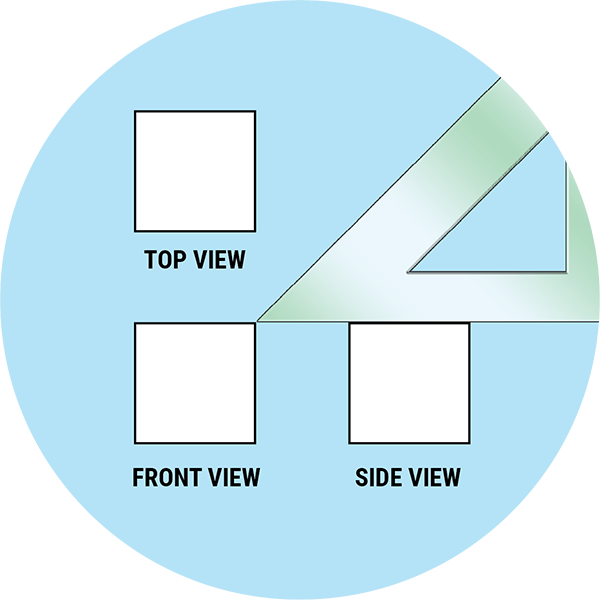
A diagram showing three labeled boxes: TOP VIEW, FRONT VIEW, and SIDE VIEW, illustrating different perspectives of an object. The background is blue with a partially unfolded corner in the upper right.
The image is completely blank with a plain white background and no visible objects, text, or features.
VCD 2024

Third Angle
Orthogonal.

In this section you will learn about 3rd Angle Orthogonal drawing. This is a means of depicting form in a group of separate two-dimensional views. It is a drawing method that is guided by a series of rules and processes set by the Australian Standards Association. Visual Communication Design follows these rules. 3rd Angle Orthogonal drawing is used in the field of Industrial design by industrial, furniture and automotive designers.

Takeaways

Black and white icon of a cheeseburger with lettuce and a cold drink in a cup with a straw, representing fast food.
Good to go
Third angle orthogonal

Third-angle orthogonal drawing is a method of depicting three-dimensional objects using separate two-dimensional views (top, front, and right side). It follows specific rules and conventions set by the Australian Standards Association to accurately communicate the sizes, features, and dimensions of objects for construction and manufacturing purposes.

  • Proper view alignment is critical
    The top view must be positioned directly above the front view, and the right side view must be properly projected using a 45-degree set square. All three views must align with each other to accurately represent the object's features and dimensions.
  • The front view determines everything
    According to Australian Standards, the front view should always be the view that communicates the most information about the object. This decision affects how you orient the top view and ultimately the entire drawing layout.
  • Line conventions and precedence matter
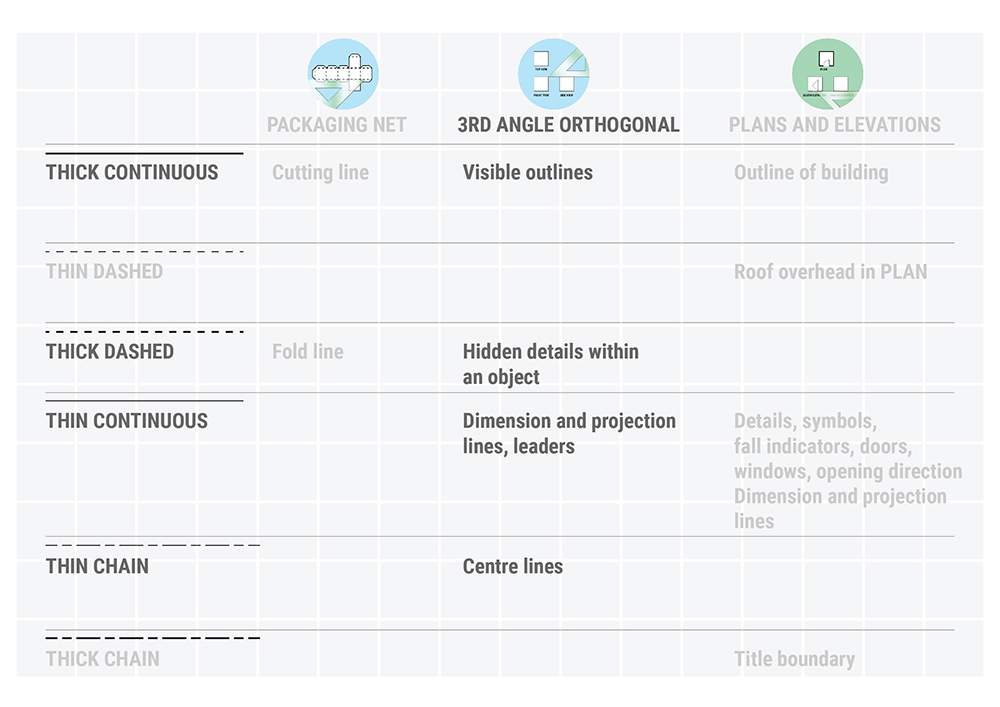
    Different line types (thick continuous for outlines, thick dashed for hidden details, thin chain for centres) serve specific purposes. When multiple lines occupy the same position, only the highest-precedence line is drawn.
  • Complete drawings require proper annotation
    A finished orthogonal drawing must include view labels, accurate dimensions, the third-angle symbol, and a title block with essential information, such as scale, date, and units. These elements transform a simple drawing into a professional manufacturing document.

Model answer
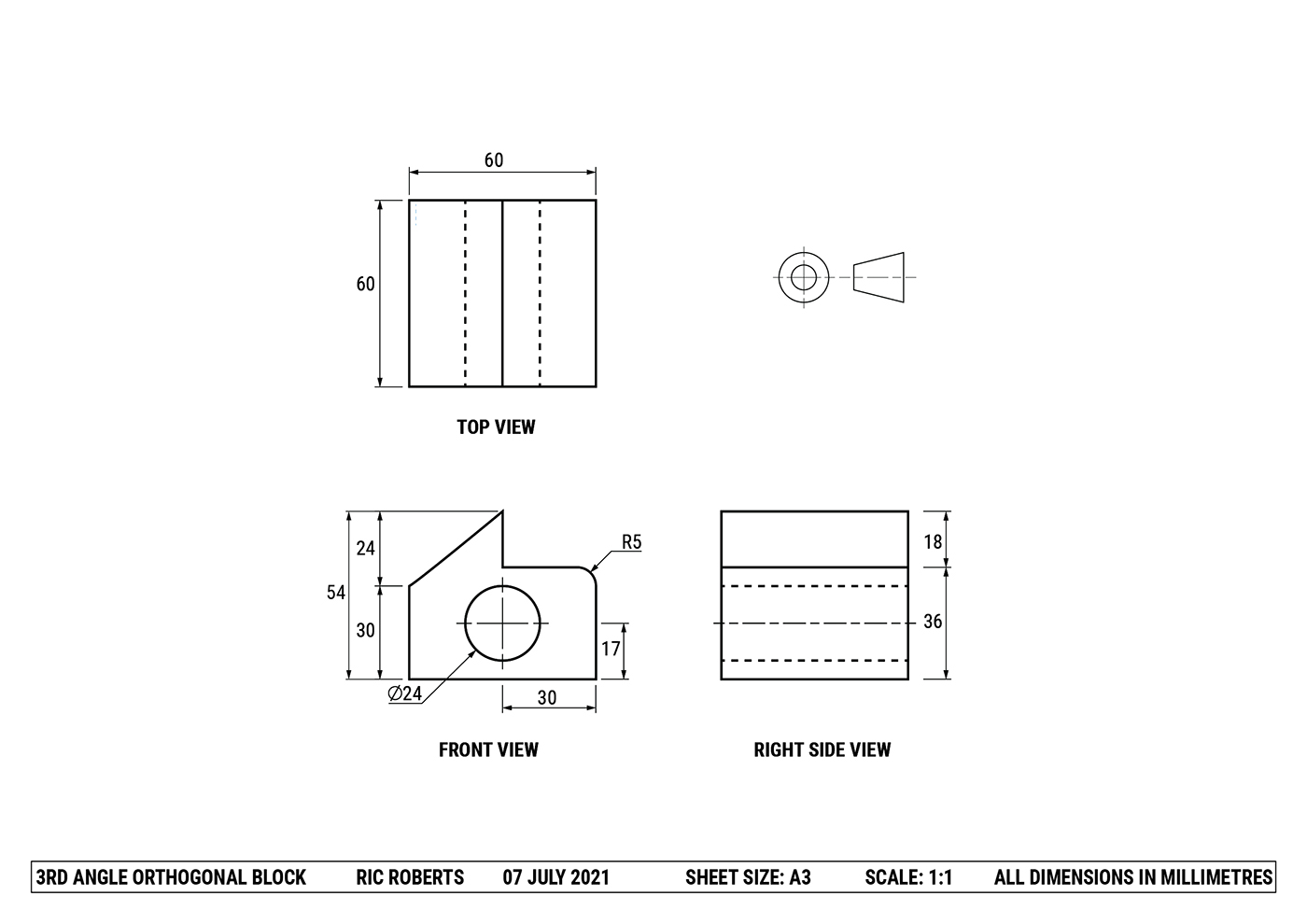
Here is a completed 3rd Angle Orthogonal drawing. The techniques and conventions for this drawing will be unpacked fully on this page.
Technical drawing of a rectangular block in third angle projection, showing top, front, and right side views, with dimensions and a circular hole. All measurements are in millimeters.

Introduction

This page will teach students about making a 3rd Angle Orthogonal Drawing. We will begin with roughly sketched drawings and move to formal instrumental presentation drawings. 3rd Angle Orthogonal drawings are in Visual Communication Design are made manually and with digital-based methods using the media of vector-based and/ or CAD programs.

The purpose of 3rd angle orthogonal drawings

3rd Angle Orthogonal drawings are used to depict the sizes and features of objects accurately for construction. They specify the dimensions of objects and their physical components. They do not show surface decorations such as colours, lines or patterns.

WHO USES THEM, WHAT ARE THEY FOR?

An Orthogonal drawing is a pretty serious kind of drawing. It contains information needed for making something accurately. Orthogonal drawings form part of a manufacturing contract between client and maker, so they must be drawn accurately and interpreted as the designer intended. If a product is made 'according to the drawing, the maker can be paid. If it's not, the drawing will be used to show where the product is wrong. Various kinds of 3rd Angle Orthogonal drawings are used by industrial designers, engineers, pattern makers and automotive designers.

In order for Orthogonal drawings to communicate details clearly, they need to be drawn correctly. A set of rules known as conventions has been created to ensure that 3rd Angle Orthogonal Drawings are always drawn consistently. These conventions set rules for the kinds of lines used, the ways to name things, the way to say how big things are and other details. These rules are in a document named: 'Australian Standards AS1100.'
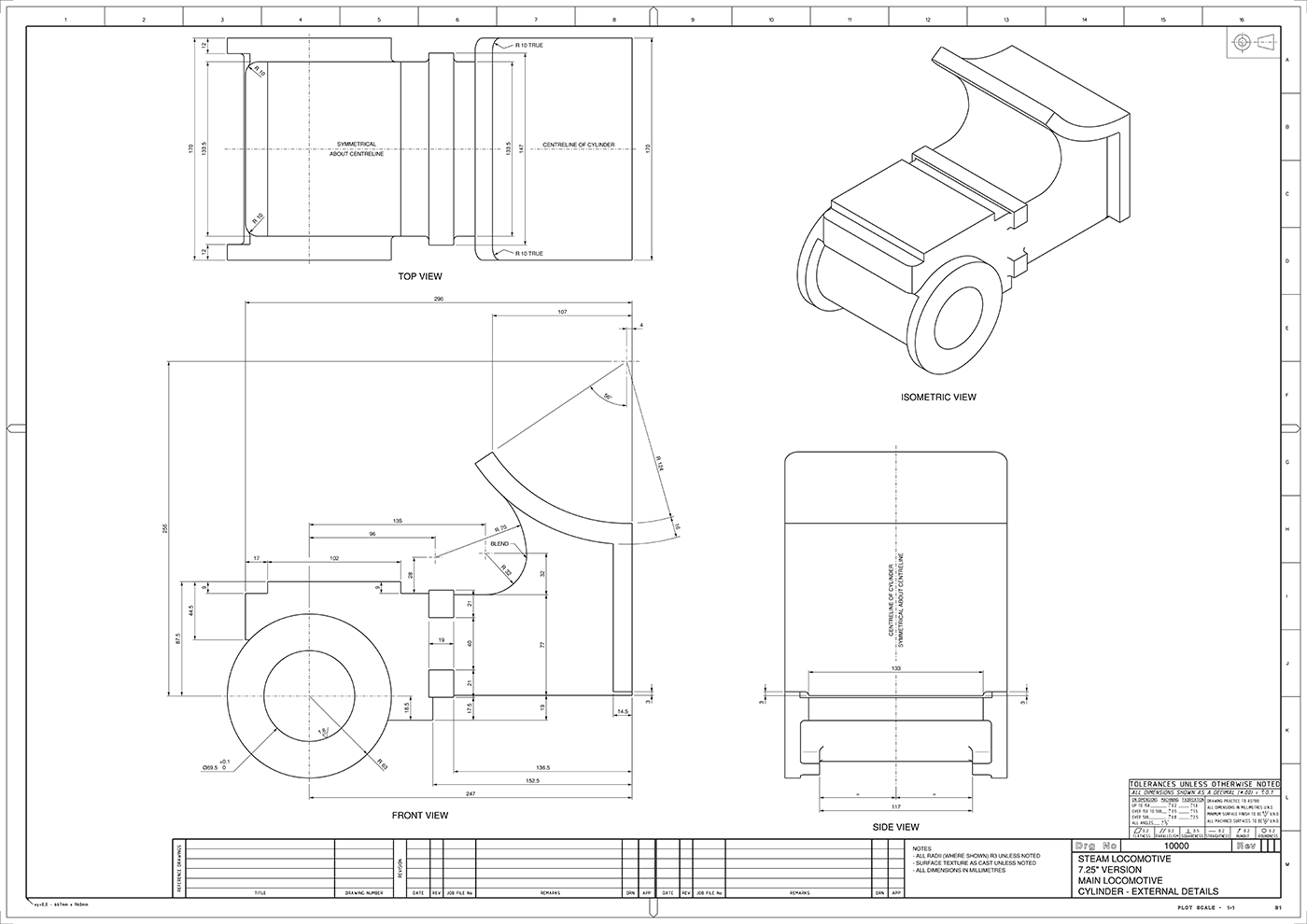
Technical engineering drawing of a mechanical part showing top, front, side, and isometric views, with dimensions, angles, and notes labeled throughout the blueprint. Title block and scale are visible in the bottom right corner.
A 3rd Angle Orthogonal Drawing of a cylinder in a scale steam locomotive. Used with permission from Pro Draft Engineering Drafting.

Making a 3rd Angle Orthogonal Drawing

There is a process for making a 3rd Angle Orthogonal drawing correctly. This section will tackle each part - step by step. It begins with a simple set-up and takes students to a completely dimensioned and finished presentation drawing.

What is a projection?

A three-dimensional object can be represented on a flat piece of paper by projecting the views away from the object onto transparent viewing planes. In this video, these planes are shown as pieces of glass. This set of flat planes is then folded out and becomes the paper on which the drawing is made.

A 3rd Angle Orthogonal drawing is a way to show a three-dimensional object on a flat piece of paper. As you would realise, we can't draw all the sides of an object at once unless we are Pablo Picasso!

Watch as I describe how the views in a 3rd Angle Orthogonal drawing relate to an object.

SETTING OUT AN ORTHOGONAL DRAWING

ORIENTATION OF THE TOP VIEW
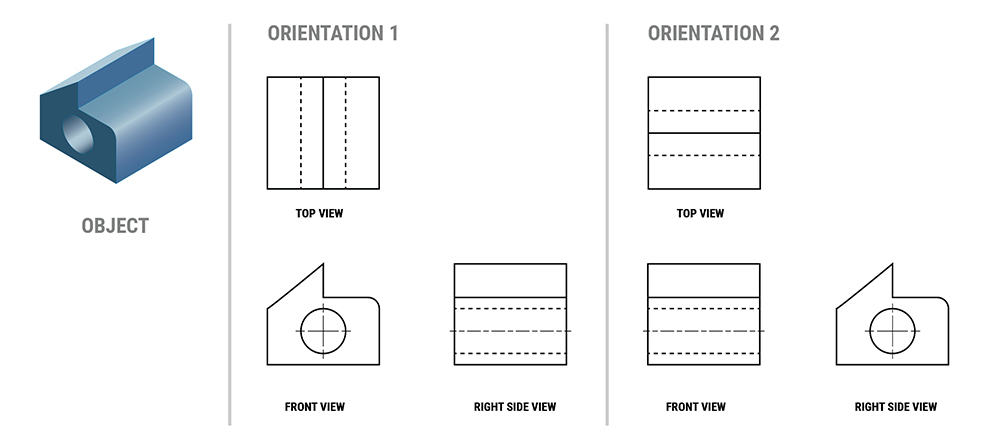
Before we start drawing, we have to determine which way we should orientate the object we want to draw. This will determine the way the TOP VIEW sits. The Australian Standards tell us that the FRONT VIEW will be the view that communicates the most information about the object. Therefore, as the FRONT VIEW is always directly under the TOP VIEW, we need to consider the orientation of the TOP VIEW, carefully.
A 3D object is shown on the left, with two sets of orthographic projections on the right labeled Orientation 1 and Orientation 2, each displaying top, front, and right side views of the object.
There are always two ways one can orientate a TOP VIEW but only one way is correct according to the Australian Standards. Which way would you go with?

Alignment

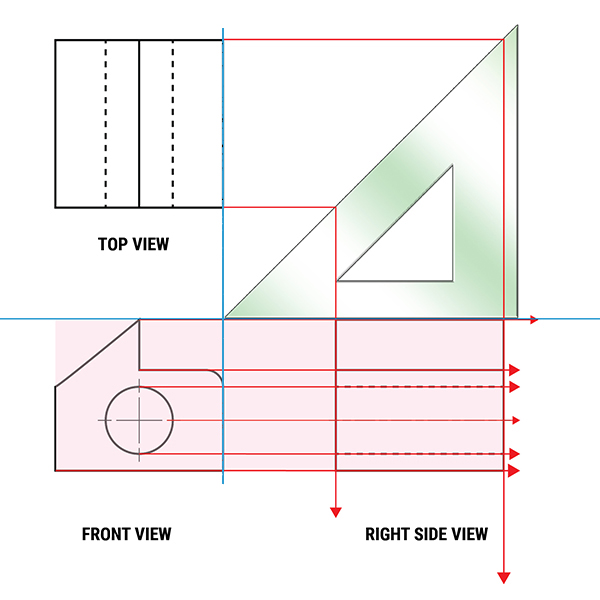
A 3rd Angle Orthogonal drawing must be set out correctly. The views must be aligned with each other. Consider how the TOP VIEW informs the FRONT VIEW and they both inform the RIGHT SIDE VIEW.
Technical drawing with front, right side, and top views of a rectangular object featuring a circular cutout in the lower right. The front view is on the left; the right side view is to its right.
Draw a TOP VIEW first. Then project the lines down for the FRONT VIEW.
A technical drawing shows orthographic projections of an object with top, front, and right side views, including construction lines and labels for each view. The right side view contains a triangular cutout.
Draw a line above the FRONT VIEW then sit a 45 degree set square on the point at the top right hand corner of this view. Project lines from the TOP VIEW to the set square then down to form the RIGHT SIDE VIEW.

task

Image

1.1 Visualise 3rd angle orthogonal

Practice taking photos of an object from the top, front and side so that the FRONT VIEW is the view that communicates the most information about your object.

1.2 sketch orthogonal

Use the photos to make a sketch 3rd angle orthogonal drawing. Don’t worry about scale or line conventions, just see if you can make the features of the object line up between the views.

Jump to

Line conventions

3rd Angle Orthogonal drawings use a small variety of line types and weights. These are shown in the chart at right.
A chart comparing line types—thick continuous, thin dashed, thick dashed, thin chain, thick chain—used in packaging nets, 3rd angle orthogonal drawings, and plans/elevations, with their specific purposes listed.

Jump to

Scale

An object is seldom represented at full size in a 3rd Angle Orthogonal drawing. Students are expected to be able to select a scale for their drawings. Selecting an appropriate scale depends on the three things;

  1. How big is the object to be represented?
  2. How much of the object is to be shown/ how many views are to be shown?
  3. What size paper will be used.

The scale used in a drawing is nominated in the Title Block. To find out how to draw accurately in scale, explore my page on Scale, linked below.
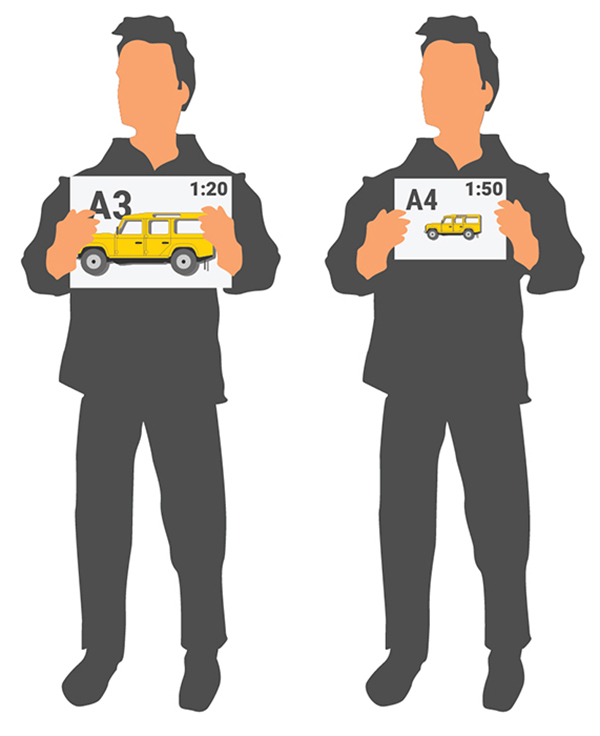
Two people holding signs: one holds an A3 sheet with a large yellow car at a 1:20 scale, the other holds an A4 sheet with a smaller yellow car at a 1:50 scale.
Selecting an appropriate scale is necessary for 3rd Angle Orthogonal drawings.

Jump to

For further information on Scale click on the link at right.
A green circle with two yellow rulers and two white lines forming the letter F in the center.

Scale

task

Image

2.1 Visualise Scales

Find 5 objects around you. Find 3 with dimensions smaller than yourself and 2 with dimensions bigger than you.

Grab a ruler or tape measure and measure the height, width and depth of each object. Write these dimensions down in a table.

Convert the dimensions for each object to sizes in millimetres for each of the following scales:

  • 2:1
  • 1:5
  • 1:10
  • 1:50
  • 1:100

2.2 Use scales

Take a sheet of A4 paper (landscape). Choose one of the objects in scale that you worked out and are sure will fit on A4 landscape. (That's W297 mm x H210 mm). Draw a front view of the object at the scale you selected. Identify the scale you have used on your drawing.

Jump to

Drawing a manual 3rd Angle Orthogonal

It's time to put what we know so far into practice. In this video I take students through the simple process of setting out and drawing a 3rd Angle Orthogonal Drawing based on the block seen above.

Don't forget to incorporate the line conventions found in the table above.

3rd Angle Orthogonal with manual method - part 1

Get started with pencil, set-square and paper.
Technical drawing with top, front, and right side views of a mechanical part. The part has a square base (60x60 mm), a circular hole (24 mm diam.), an angled cut, and detailed measurements are shown in each view.
Use this illustration for dimensions for your 3rd Angle Orthogonal.

task

Image

3.1 Manual 3rd Angle Orthogonal

Watch the video above and draw your own 3rd Angle Orthogonal.

3.2 Manual 3rd Angle Orthogonal

Choose one of the objects below and make a manual 3rd Angle Orthogonal drawing of it. Choose and apply an appropriate scale to represent the TOP, FRONT, RIGHT SIDE VIEWS on a sheet of A4 paper.
A diagram shows a brown chair with labeled dimensions and a yellow house-shaped block with its size measurements. The chair measures 800x400x400 mm; the block measures 15x10x20 units with a triangular roof.

Jump to

Labels and dimensions

In this step students will learn how to finish their 3rd Angle Orthogonal drawing with labels, dimensions, the symbol and a title box.

Labels

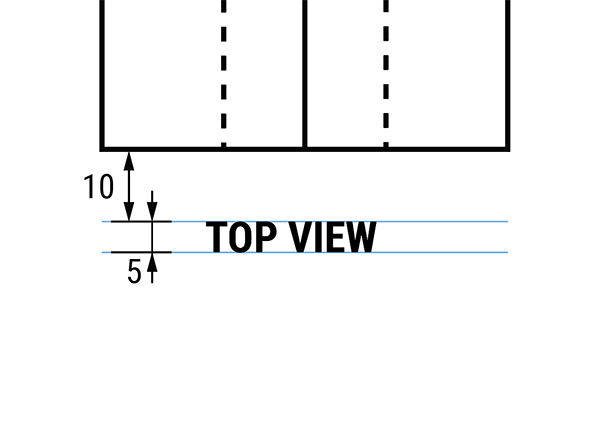
Each view in a 3rd Angle drawing must be labelled in a consistent way. The names for each view and the dimensions used to set up labels are shown here. Sans-serif capitals are used.
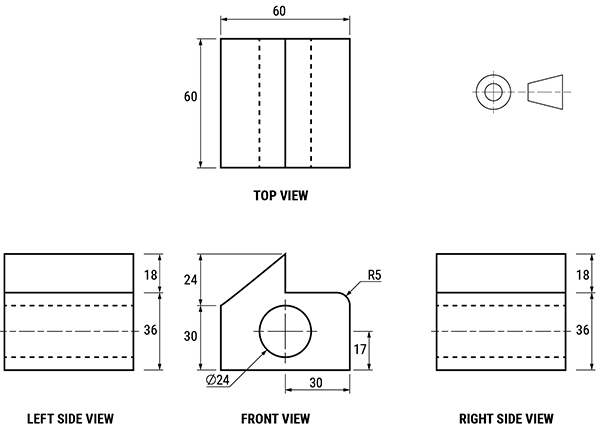
Technical drawing showing top, front, left, and right side views of a mechanical part with dimensions, holes, dashed lines indicating hidden features, and various measurements in millimeters.
There are four different names for the views in 3rd Angle orthogonal drawings.
A technical drawing label reads TOP VIEW in bold black letters, with two vertical double-headed arrows showing dimensions of 10 and 5 units on the left side.
Use these recommended dimensions for constructing the name labels.

Jump to

Dimensions

Dimensions in 3rd Angle Orthogonal drawings are annotations that indicate sizes of objects and/ or components. There are several kinds of dimensions for different parts of objects. In addition, Australian Standards shows several different acceptable ways to dimension components. This page will illustrate only one way for each dimension style.

Note: Dimension numbers identify the sizes of parts of the actual object and not the size of them as they appear in a drawing. Therefore; dimensions for the side of an object use the same number even when different views are at different scales.

Overall and intermediate Dimensions

Overall dimensions refer to the size of one complete side of an object.

Intermediate dimensions refer to the sizes of components of an object situated on one side.
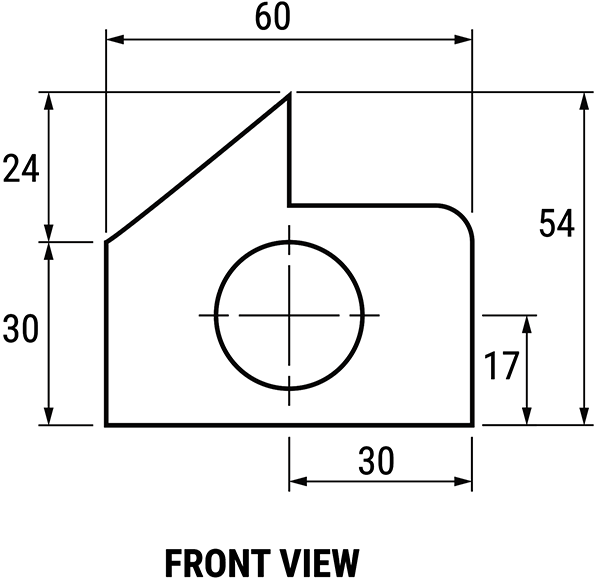
Technical drawing labeled FRONT VIEW shows a geometric shape with a slanted top left side, a central circle, and various dimensions: 60 wide, 54 tall, with labeled measurements of 24, 30, and 17 units.
There are four different names for the views in 3rd Angle orthogonal drawings.

Linear dimensions

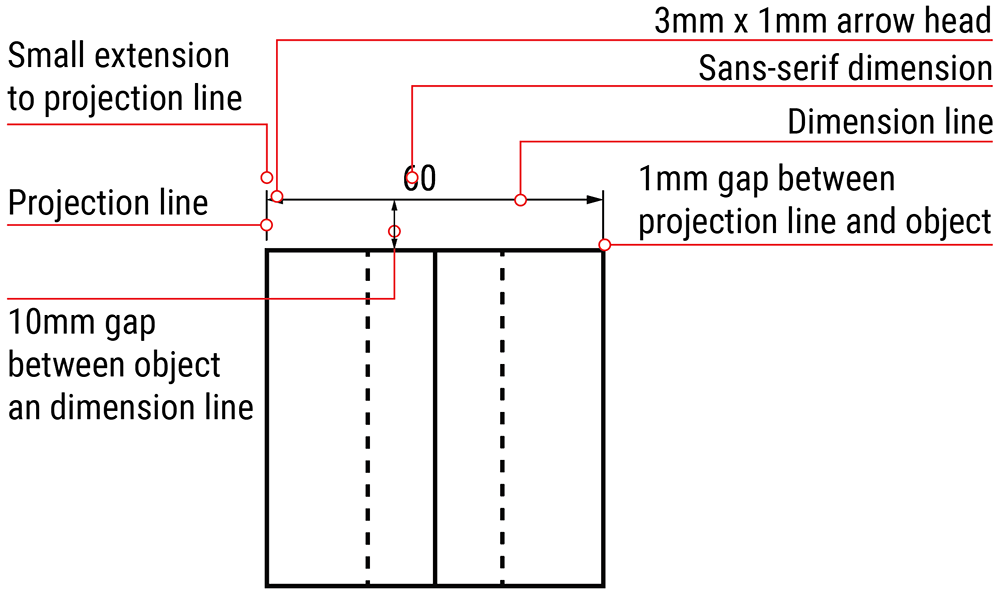
Refer to the image at right for the components and requirements of setting out dimensions between two points in 3rd Angle Orthogonal drawings.
A technical drawing diagram showing proper dimensioning: projection lines, dimension line with 3mm x 1mm arrowhead, sans-serif “60” label, 10mm and 1mm gap notes, and small extension to projection line.
Components of linear dimensions.

Dimensioning circles and arcs

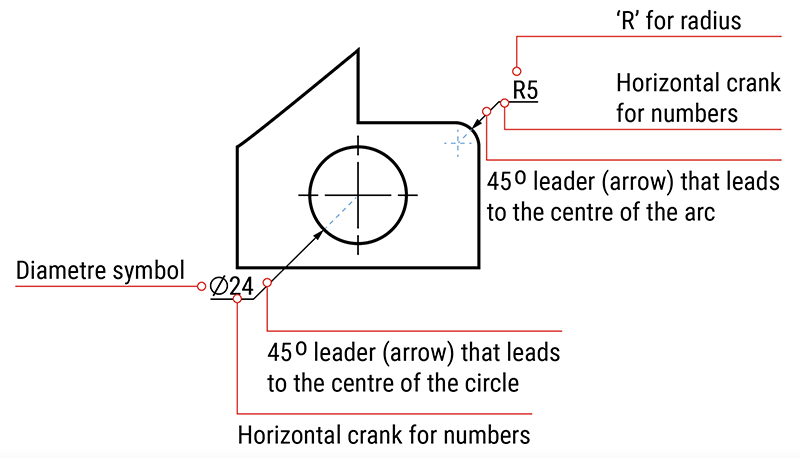
Refer to the image at right for the components and requirements of setting out dimensions of circles and arcs in 3rd Angle Orthogonal drawings.
Technical drawing showing a geometric shape with a central circle, labeled diameter (⌀24) and radius (R5), arrows indicating dimensions, and notes on leader arrows and horizontal cranks for numbers.
Components of dimensions for circles and arcs.

Jump to

Symbol

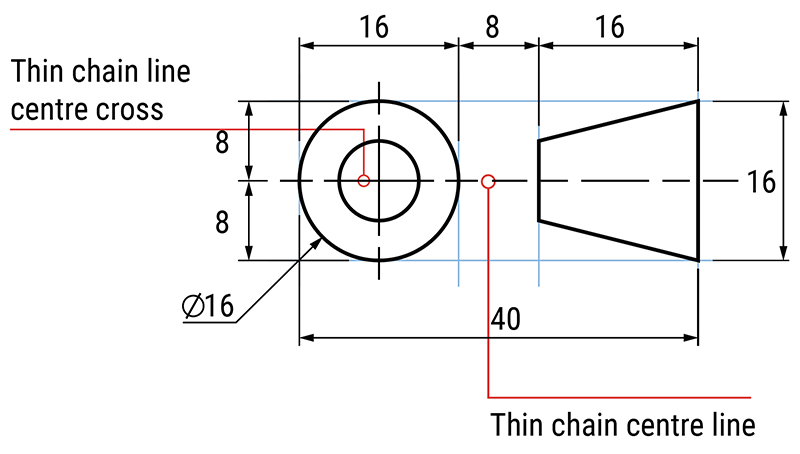
Refer to the image at right for setting up your 3rd Angle Orthogonal drawing symbol. This is required for all drawings of this method.
Technical drawing showing a side and front view of a cylindrical object with a conical extension. Dimensions and center lines are labeled, with key measurements such as 16, 8, and 40 units.
Recommended set up and components for the 3rd Angle Orthogonal symbol.

Jump to

CAUTION

Image

Lines of precedence

Did you know that when two kinds of lines in a 3rd Angle Orthogonal are in the same position, they are not seen together? Only one kind of line is seen at one time. This idea is known as 'lines of precedence' and means that certain kinds of lines take precedence over others. (Precedence means seen first). The order for showing lines that occur together is;

  1. Thick continuous (outlines)
  2. Thick dashed (hidden details)
  3. Thin chain lines (centres)

Examine the following image to see how only one line has been drawn in the middle of the TOP VIEW. Use the FRONT VIEW to help understand the form.

Six diagrams showing top and front views of objects, illustrating rules for line precedence: outlines take precedence over hidden and centre lines; hidden lines take precedence over centre lines. Labels highlight these rules.

Jump to

Putting it together: manual and digital

This section examines the process for creating labels, dimensions and the 3rd Angle Orthogonal symbol. Watch the videos below to consolidate your learning.
3rd Angle Orthogonal with manual method - part 2
Finishing your drawing with labels, dimensions and the 3rd Angle Orthogonal symbol.
3rd Angle Orthogonal with digital method - part 1
Drawing the same 3rd Angle Orthogonal of the block in Adobe Illustrator.
3rd Angle Orthogonal with digital method - part 2
Finishing your drawing with labels, dimensions and the 3rd Angle Orthogonal symbol.

task

Image

4.1 Labels

Label the views in your manual drawing you made in Task 2.2 above

4.2 Dimensions

Make a manual 3rd Angle Orthogonal drawing of a single hole pencil sharpener. Don't forget to include hidden lines and centre lines for the hole. Dimension this drawing to show;

  • overall height, width and depth
  • at least one intermediate dimension
  • the diametre of the outside circle

Refer to the images above for Australian Standards conventions.

4.3 Symbol

Using the image that shows the dimensions of the 3rd Angle Orthogonal symbol as a reference, make a poster that could be placed in a classroom that would teach students what the symbol is used for, how it assists with the reading of the drawing and how to construct it properly.

4.4 lines of precedence

Construct a FRONT and TOP VIEW of a block that has two lines that are in the same position. (Ensure that your block is a different shape from the ones shown above). Using your knowledge draw in the line that should take precedence.

For an extension activity try to create two lines in the same position on the FRONT VIEW and draw the correct line.

Jump to

Title Block

The final part of creating your 3rd Angle Orthogonal drawing is to make your title block. The title block is usually situated at the bottom of you page and extends across from the left to right margin. It may be an enclosed or open box that is defined by lines. It should include;

  • the title of the drawing
  • the student name
  • date drawn
  • scale used
  • sheet size
  • reference to units used in the dimensions
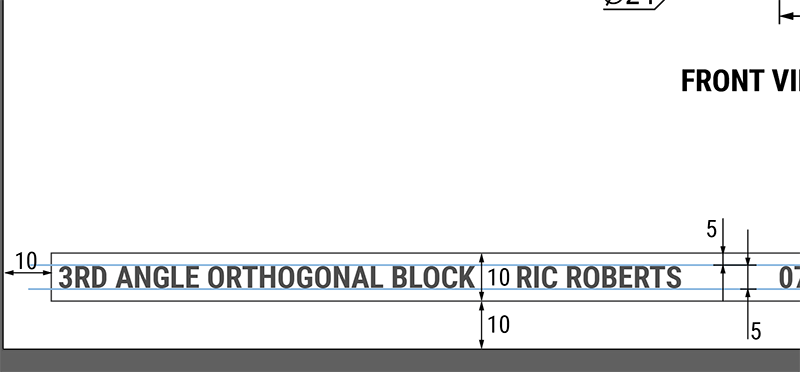
A technical drawing detail showing the text 3RD ANGLE ORTHOGONAL BLOCK 10 RIC ROBERTS labeled inside a rectangular box, with measurement lines indicating dimensions of 5 and 10 units.
Recommended dimensions for setting up a title block on an A3 sheet.

task

Image

5.1 Lego orthogonal

Use Lego or other blocks to create a complex form. Photograph it using your camera from three different angles to use as reference for your drawing.

Make a completed 3rd Angle Orthogonal using the processes described on this page. Don't forget to follow the steps for selecting an appropriate scale, add labels, dimensions, symbol and title block in accordance with Australian Standards and VCAA Technical Drawing Specifications.

Use a manual or digital method as directed by your teacher.

Jump to